

Our latest musings on all things AQ and how to strengthen your own adaptability muscles!
Unlearning has fallen across 19,077 assessments. Here is what that means for organisations.
Adaptability is not one thing. Find your constraint before buying the solution.

Resilience is real, but it was never meant to carry adaptation alone.
Managers dropped nine points while their teams held steady. That gap is the story.
The word stopped carrying information. Here is the question that puts it back.
Nothing feels permanent because every anchor is moving. The answer is inner adaptability.

Motivation Style is the direction of your drive, and it is a preference.

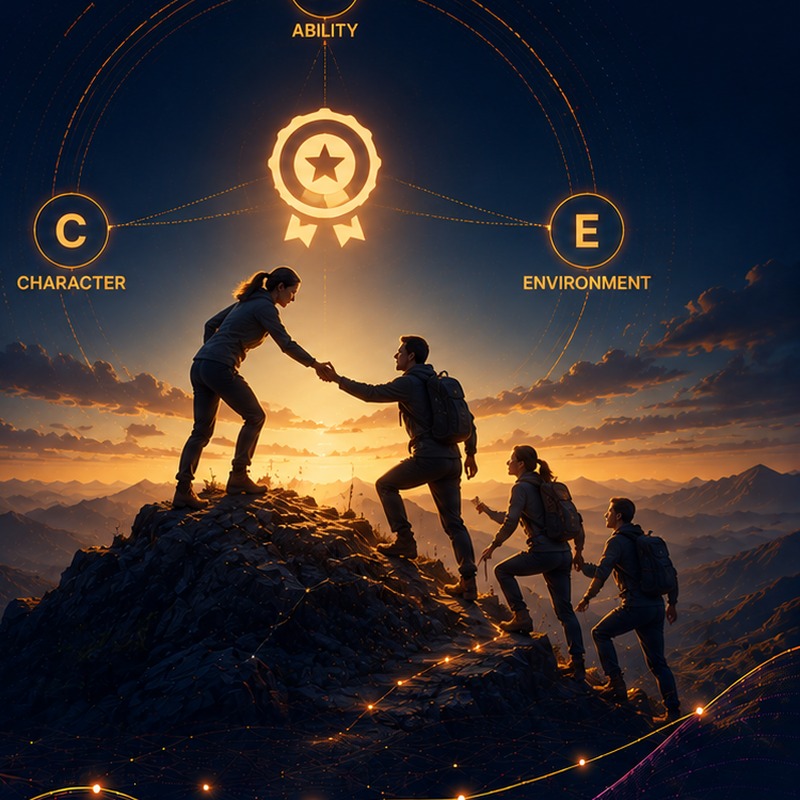
Adaptability is measured with the A.C.E. model: Ability, Character, Environment.
How to become a certified adaptability coach and measure AQ with the A.C.E. model.

AQ is the measurable capacity to adapt to change, explained.

Resilience is the capacity to recover quickly, and it is trainable.
AI rollouts fail at the human, not the model. Unlearning is the metric.
The Big Four measure the organisation. A.C.E. measures the human inside it.
The two questions that make change work: ADKAR's stage and AQ's conditions.
How Prosci's ADKAR and AQai's ACE work together as complementary change tools.
Adaptability is a muscle: measurable, trainable, and the next leadership standard.

Transformation builds capacity. Stress tests consume it. Most leaders cannot tell them apart.
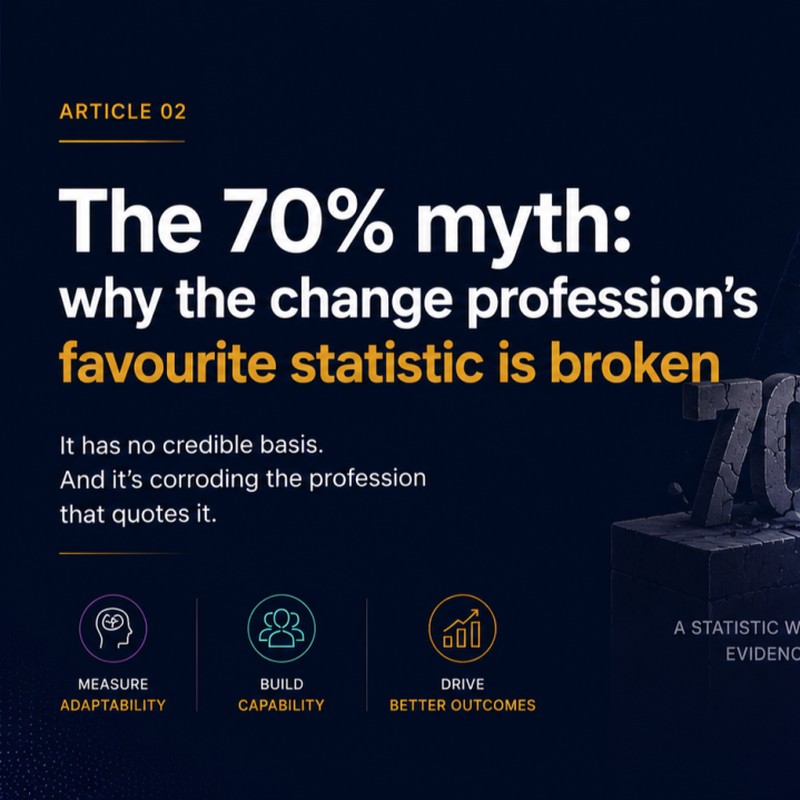
The change profession's favourite statistic, '70% of transformations fail', has no empirical basis.
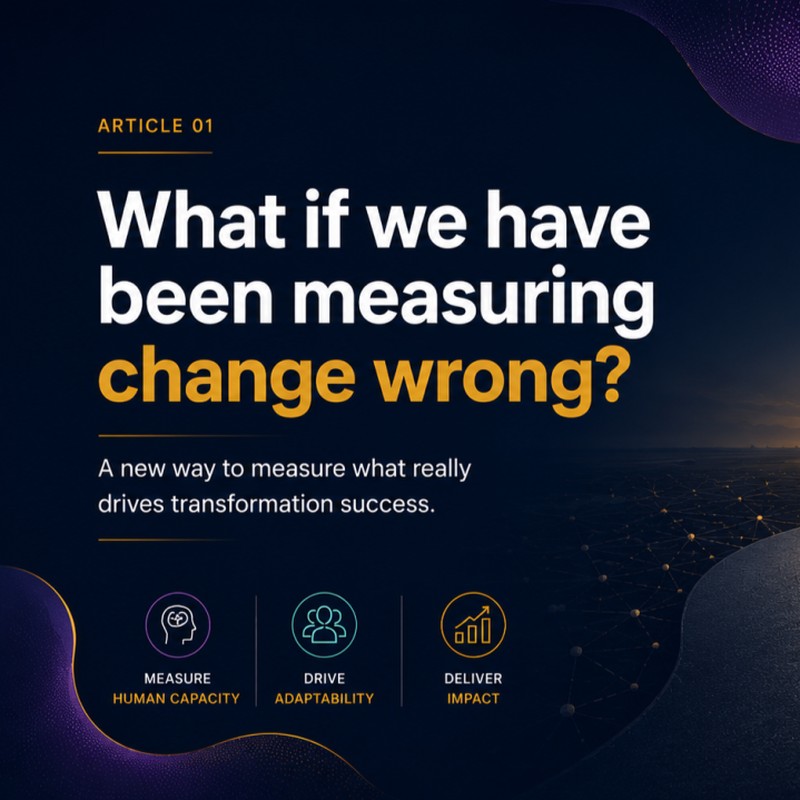
Every transformation tracks plans and comms. None measure human capacity to absorb change.

Let’s lift the lid on the concept of Motivation Style, as explored in Ross Thornley's "Decoding AQ: Your Greatest Superpower."

Key Takeaways from "The Future-Ready L&D Professional: Unleashing Adaptability and Growth in the Age of Rapid Change, by Ross Thornley, MABP , June 2023.

Timeless insights into navigating the intertwined paths of technological advancement and emotional well-being.

From The Leader's Ultimate Guide To Successful Transformation: The Corporate Immune System

As we explore in the AQai book "Decoding AQ," authored by our co-founder Ross Thornley, true adaptability involves embracing the key cycles of change.

Key Takeaways from Decoding AQ, Your Greatest Superpower, by Ross Thornley, MABP, 2022.


Staying ahead of the curve is not just about responding to change, but predicting and influencing it.

There’s nothing like a global pandemic to make VUCA personal and break our human addiction to certainty.

Futurists such as Ray Kurzweil have argued that technological changes are accelerating today at such....

When you invest your time, energy, and trust in someone to lead, it can be painful to watch them go...
78% of US workers say job security no longer exists without continuous adaptation, and 85% say upskilling is no longer a choice, yet only 71% are actually doing it. ETS calls the gap adaptability paralysis. The deeper problem is that adapt names a category, not an action. Read through the AQ model, adaptability is a pattern across Ability, Character and Environment, and buying a course only addresses one of them.
Resilience is the capacity to recover after a setback. Adaptability is the broader capacity to change how you think, work and respond. This piece explains the difference, why resilience language now grates on people, and what actually helps when recovery is being asked to do a job it cannot do alone.
Gallup's State of the Global Workplace 2026 found manager engagement fell nine points since 2022, from 31% to 22%, while engagement among the people they lead moved only one point. Spans of control widened and the management layer thinned over the same period. Here is why that pattern points at conditions rather than character, read through Ability, Character and Environment.

With the rise of machine-learning, robotics, sensors, algorithms, and AI, it’s becoming clear that humanity cannot continue to thrive in the same way we used to. Everywhere, professions are being challenged and in some areas outright outmoded by technological innovations, leaving us with questions as to who we are, our very identity, and how we can make a difference in this ever-changing world.
In an era marked by rapid technological advancements and shifting market dynamics, the corporate landscape faces a continuous state of flux. Challenges like managing remote work, embracing digital transformation, and keeping employees engaged have become commonplace. In this evolving scenario, Adaptability emerges as a critical skill for both leaders and employees.
AQai co-founder Mike Raven led a follow-up to the AQai and Prosci webinar: asking both the stage question (ADKAR) and the conditions question (AQ). Three worked cases show the combined diagnostic in action.
A clear, answer-first guide to becoming a certified adaptability coach: what the role involves, how AQ is measured through the A.C.E. model, the AQ Level 1 Certification pathway, and why the credential is worth it in 2026.
What resilience is in the AQ model, why it matters more than ever, and five evidence-based ways to build it, plus three exercises to try this week.
AQai's Ross Thornley and Prosci's Tim Creasey hosted a joint webinar on 6 May 2026. Here is how the ACE model and ADKAR work together as complementary tools for change leaders.

The primary value drivers throughout the Third industrial revolution were the biological hegemony of survival of the fittest, and its economic analog in capitalism, that profits flow to the shareholders. Biologists, economists, and climatologists today suggest that as a species we did diversify through competitive advantage. However, we evolved by integrating through collaborative advantage to optimize the whole system.
AQai analysed 19,077 first AQ assessments from 2020 to August 2026. Mental Flexibility has held steady, but Unlearning, the ability to deliberately let go of what you know, has been falling. Here is what the data shows, what it does not, and the one question to ask your organisation.
Resilience is the capacity to recover after a setback. Adaptability is the broader capacity to change how you think, work and respond. This piece explains the difference, why resilience language now grates on people, and what actually helps when recovery is being asked to do a job it cannot do alone.
Futurists such as Ray Kurzweil have argued that technological changes are accelerating today at such unprecedented speed that it’s hard to even imagine what our world will look like in a decade. We could see more change in the next 10 years than we have in the previous 100. The World Economic Forum reports that 40% of jobs that exist today will not exist in 10 years. As we approach the 1-year anniversary of global lockdowns due to the Pandemic, it’s clear the world of work will never be the same. This pace of change is quickening, and that level of change and uncertainty can create a great deal of fear.
Nothing feels permanent because the tools, roles, and paths people anchored to are all shifting at once. The real source of stability was never permanence, it was your capacity to adapt, and that is something you can build.

Simply put, because they are able to win more business, do more interesting projects, and have an even greater impact. Several essential leadership qualities have been recognised, researched and discussed over the years in many journals. Qualities like communication, creativity, critical thinking, and empathy. However, just about every major study - from the World Economic Forum, and Deloitte, to Mckinsey, Linkedin and PWC - are placing ‘adaptability’ as the #1 essential skill of our time. Even citing adaptability as the leading delta in employability, and success.
Every transformation programme tracks plans, milestones, and comms cadence. None of them measure the human capacity to absorb the change. That is why many fail.
Gallup's State of the Global Workplace 2026 found manager engagement fell nine points since 2022, from 31% to 22%, while engagement among the people they lead moved only one point. Spans of control widened and the management layer thinned over the same period. Here is why that pattern points at conditions rather than character, read through Ability, Character and Environment.
Almost every change-management deck cites '70% of transformations fail'. And when you dig deeper, the number has no credible empirical basis. And it is corroding the profession that quotes it. (I have been guilty of this in the past, too!)
An open note to Deloitte, PwC, EY and KPMG: your transformation frameworks have a human-side layer they cannot see. A.C.E. is what completes them, built to be partnered with, not competed against.
Understanding what drives us and keeps us motivated, especially during challenging times, is essential for personal and professional success. In today’s article, we are not going to be talking about ‘what someone is motivated by, i.e. money, fame, friendships, mastery or meaning’, but how you can leverage critical people data to inform practical communication strategies to shift responses of change from friction to flow. Let’s lift the lid on the concept of Motivation Style, as explored in Ross Thornley's "Decoding AQ: Your Greatest Superpower."
Adaptive leadership is a new way of thinking, one with humility, vulnerability and more questions than answers at the heart. A stark contrast from the ‘tried & true’ methods that experience and time on the job gifted many leaders of the past. It emphasizes the need for leaders to be agile, learn continuously, and excel in unpredictable environments. In this edition, we revisit a crucial chapter from "The Future-Ready L&D Professional" by AQai co-founder Ross Thornley. We dive into adaptive leadership's core, the significance of Adaptability Intelligence (AQ®), making decisions amidst uncertainty, sparking innovation, and building an environment conducive to leadership and team growth.
What motivation style is, why it is a preference not a competence, and how to build range across Play to Protect, Contextual and Play to Win.
The AI rollout is technically perfect, but the team is not using it. This is not an AI problem, it is an adaptability problem. Here is the metric that predicts which rollouts land.
Staying ahead of the curve is not just about responding to change, but predicting and influencing it. The reality is that it’s not only technology that is rapidly changing our world, but the strategic by-products from access to tremendous amounts of information. We have more data than perhaps ever before in human history. A strange paradox exists; we hold an abundance of information on on the subject of nutrition and optimum human health, but we also have a crisis of health on our hands. At least in the West, where obesity levels are at an all time high (almost a third of adults in the UK are now clinically ‘obese’).
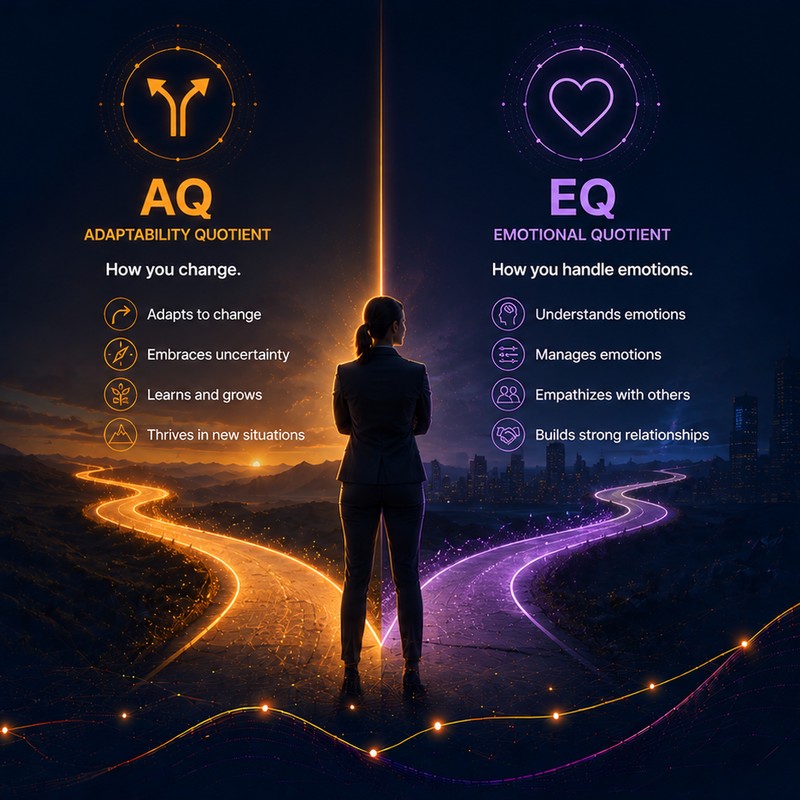
Adaptability Quotient and Emotional Intelligence are related but distinct. Here is exactly how AQ and EQ differ, where they overlap, and why modern work demands both.
I was introduced to the acronym VUCA in the early 2000s while writing my first book Perfect Labor Storm. After the convergence and accumulation of events that disrupted our lives in the past 18 months, I can’t think of a more fitting description than VUCA - Volatile, Uncertain, Complex, Ambiguous.
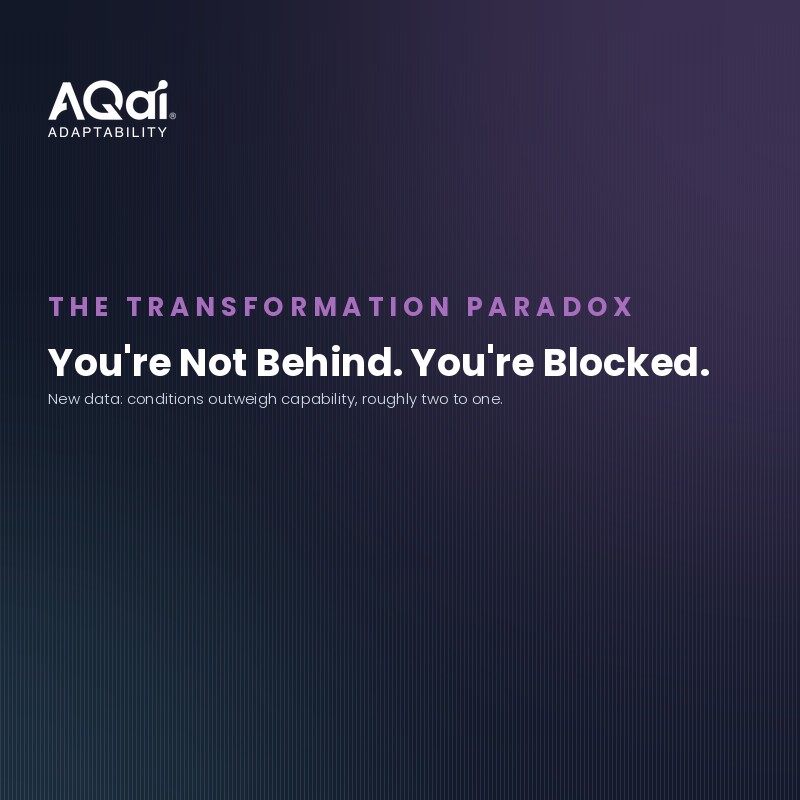
Microsoft's 2026 Work Trend Index found that organisational factors account for 67% of the reported impact of AI at work, against 32% for individual mindset and behaviour, and that 10% of AI users sit in blocked agency: skilled, and unsupported. Read through the AQ A.C.E. model, that is an Environment constraint being misdiagnosed as a skills gap.

In general, when we talk about our rapidly changing world, we talk about humans and technology in isolation, as though the two are naturally separated, or worse as two opposing forces in a battle for supremacy. However, I believe technology is inert until we give it a purpose, and at it’s best, when augmented alongside humans, it can unlock opportunities and accomplish solutions never-before-possible. Technology has always had a symbiotic relationship with humankind, and informed the way we interact with the world around us.
Reflecting on a pivotal past episode of "Decoding AQ," featuring Mark Metry and hosted by Ross Thornley, we revisit the enduring relevance of their discussion on technology's role in shaping our own emotional health.
PwC analysed more than one billion job ads and found a two-track labour market: roles professionalised by AI, where judgement is emphasised, and roles democratised by AI, where the work gets easier for non-experts. Here is how to tell which track your role is on, read through Ability, Character and Environment.
Most adaptability courses give everyone the same generic content. The best ones measure your adaptability first, then teach to your gaps. Here is what to look for, how resilience courses, coaching and certification compare, and why AQ Essentials is the strongest place to start.
When you invest your time, energy, and trust in someone to lead, it can be painful to watch them go.
As we explore in the AQai book "Decoding AQ," authored by our co-founder Ross Thornley, true adaptability involves embracing the key cycles of change. Understanding and leveraging these cycles will help us remain sane, experience less frustration and with intentionality, feel a little more accomplished as we say good night each day. Enhancing our Adaptability Quotient (AQ) will help us navigate through change more effectively.
78% of US workers say job security no longer exists without continuous adaptation, and 85% say upskilling is no longer a choice, yet only 71% are actually doing it. ETS calls the gap adaptability paralysis. The deeper problem is that adapt names a category, not an action. Read through the AQ model, adaptability is a pattern across Ability, Character and Environment, and buying a course only addresses one of them.
At AQai, we believe that adaptability is a cornerstone of success, period. One of the key dimensions of adaptability is Grit, a concept extensively studied by psychologists like Angela Duckworth and Martin Seligman. But what exactly is Grit, and how does it differ from Resilience?

Adaptability has been described by the Harvard Business Review as ‘the new competitive advantage’. 2018 LinkedIn data revealed that adaptability topped the top five soft skills that employers were looking for in new candidates.

It is in the most extreme situations we witness the best and worst of humanity. But what makes us turn one way or another? Difficult situations, ones perceived outside of our control, are the moments in life when choosing how to show up creates waves of immeasurable impact. Impact on ourselves, our family, our community, our Nation and our planet.
Adaptability Quotient (AQ) is the measurable capacity of a person, team or organisation to adapt to change. What it means, how it differs from IQ and EQ, how it is measured, and how to improve it.

The fourth industrial revolution is distinguished from the previous three because it acknowledges the interdependence and undeniable synergy between the quality of human life and the way work is accomplished.
There is a moment in every change programme where the line between adaptive challenge and human overload gets crossed. I've seen many leaders cross it without noticing.
I wrote "the future belongs to those who train their adaptability muscle" in 2022. The instrument has now caught up with the metaphor. Here is what over 2 million datapoints on AQ tells us about what to train, and where most leaders get the read wrong.
What grit is, how it differs from resilience, why it matters now, and five evidence-based ways to build it, plus when not to.

Earlier this year, the BBC published a series of articles on the 101 ways worklife is changing today. One of the most interesting articles, by Lisa Leong, discussed adaptability quotient, and its importance in the modern workplace. In fact, Leong went so far as to describe AQ as the ‘X-factor for career success.’

In our exponential world, everything could (will) change tomorrow, and the pace of change is increasing, doubling in fact, in accordance with Moore’s law. Soon, we will approach the singularity, where the outcomes of change will become impossible to predict. How can we cope with this rapidly approaching moment of transformation?
The Adaptability Quotient (AQ) assessment can be a useful tool for evaluating how adaptability influences behaviors that impact customer satisfaction. Adaptability, in this context, refers to an individual's or an organization's ability to adjust effectively to new conditions, challenges, or environments, which is particularly relevant in customer service roles. Here's how the AQ assessment could be applied to Customer Service Best in Class
How is adaptability quotient measured? A plain guide to the A.C.E. model (Ability, Character, Environment), the science behind AQ, and how it differs from EQ and DISC.
"Change" now covers everything from a new expense system to a restructure, so it no longer tells anyone what is being asked of them. The volume is documented, and so is the fall in willingness to support it. Here is what to ask instead, read through Ability, Character and Environment.

Lorem ipsum dolor sit amet, consectetur adipiscing elit. Suspendisse varius enim in eros elementum tristique. Duis cursus, mi quis viverra ornare, eros dolor interdum nulla, ut commodo diam libero vitae erat. Aenean faucibus nibh et justo cursus id rutrum lorem imperdiet. Nunc ut sem vitae risus tristique posuere.
In general, when we talk about our rapidly changing world, we talk about humans and technology in isolation, as though the two are naturally separated, or worse as two opposing forces in a battle for supremacy. However, I believe technology is inert until we give it a purpose, and at it’s best, when augmented alongside humans, it can unlock opportunities and accomplish solutions never-before-possible. Technology has always had a symbiotic relationship with humankind, and informed the way we interact with the world around us.
The AI rollout is technically perfect, but the team is not using it. This is not an AI problem, it is an adaptability problem. Here is the metric that predicts which rollouts land.
I was introduced to the acronym VUCA in the early 2000s while writing my first book Perfect Labor Storm. After the convergence and accumulation of events that disrupted our lives in the past 18 months, I can’t think of a more fitting description than VUCA - Volatile, Uncertain, Complex, Ambiguous.
Adaptability Quotient and Emotional Intelligence are related but distinct. Here is exactly how AQ and EQ differ, where they overlap, and why modern work demands both.
Simply put, because they are able to win more business, do more interesting projects, and have an even greater impact. Several essential leadership qualities have been recognised, researched and discussed over the years in many journals. Qualities like communication, creativity, critical thinking, and empathy. However, just about every major study - from the World Economic Forum, and Deloitte, to Mckinsey, Linkedin and PWC - are placing ‘adaptability’ as the #1 essential skill of our time. Even citing adaptability as the leading delta in employability, and success.
Adaptive leadership is a new way of thinking, one with humility, vulnerability and more questions than answers at the heart. A stark contrast from the ‘tried & true’ methods that experience and time on the job gifted many leaders of the past. It emphasizes the need for leaders to be agile, learn continuously, and excel in unpredictable environments. In this edition, we revisit a crucial chapter from "The Future-Ready L&D Professional" by AQai co-founder Ross Thornley. We dive into adaptive leadership's core, the significance of Adaptability Intelligence (AQ®), making decisions amidst uncertainty, sparking innovation, and building an environment conducive to leadership and team growth.
AQai analysed 19,077 first AQ assessments from 2020 to August 2026. Mental Flexibility has held steady, but Unlearning, the ability to deliberately let go of what you know, has been falling. Here is what the data shows, what it does not, and the one question to ask your organisation.
Reflecting on a pivotal past episode of "Decoding AQ," featuring Mark Metry and hosted by Ross Thornley, we revisit the enduring relevance of their discussion on technology's role in shaping our own emotional health.
It is in the most extreme situations we witness the best and worst of humanity. But what makes us turn one way or another? Difficult situations, ones perceived outside of our control, are the moments in life when choosing how to show up creates waves of immeasurable impact. Impact on ourselves, our family, our community, our Nation and our planet.
Earlier this year, the BBC published a series of articles on the 101 ways worklife is changing today. One of the most interesting articles, by Lisa Leong, discussed adaptability quotient, and its importance in the modern workplace. In fact, Leong went so far as to describe AQ as the ‘X-factor for career success.’
Understanding what drives us and keeps us motivated, especially during challenging times, is essential for personal and professional success. In today’s article, we are not going to be talking about ‘what someone is motivated by, i.e. money, fame, friendships, mastery or meaning’, but how you can leverage critical people data to inform practical communication strategies to shift responses of change from friction to flow. Let’s lift the lid on the concept of Motivation Style, as explored in Ross Thornley's "Decoding AQ: Your Greatest Superpower."
In our exponential world, everything could (will) change tomorrow, and the pace of change is increasing, doubling in fact, in accordance with Moore’s law. Soon, we will approach the singularity, where the outcomes of change will become impossible to predict. How can we cope with this rapidly approaching moment of transformation?
What grit is, how it differs from resilience, why it matters now, and five evidence-based ways to build it, plus when not to.
Every transformation programme tracks plans, milestones, and comms cadence. None of them measure the human capacity to absorb the change. That is why many fail.
Staying ahead of the curve is not just about responding to change, but predicting and influencing it. The reality is that it’s not only technology that is rapidly changing our world, but the strategic by-products from access to tremendous amounts of information. We have more data than perhaps ever before in human history. A strange paradox exists; we hold an abundance of information on on the subject of nutrition and optimum human health, but we also have a crisis of health on our hands. At least in the West, where obesity levels are at an all time high (almost a third of adults in the UK are now clinically ‘obese’).
At AQai, we believe that adaptability is a cornerstone of success, period. One of the key dimensions of adaptability is Grit, a concept extensively studied by psychologists like Angela Duckworth and Martin Seligman. But what exactly is Grit, and how does it differ from Resilience?
Futurists such as Ray Kurzweil have argued that technological changes are accelerating today at such unprecedented speed that it’s hard to even imagine what our world will look like in a decade. We could see more change in the next 10 years than we have in the previous 100. The World Economic Forum reports that 40% of jobs that exist today will not exist in 10 years. As we approach the 1-year anniversary of global lockdowns due to the Pandemic, it’s clear the world of work will never be the same. This pace of change is quickening, and that level of change and uncertainty can create a great deal of fear.
I wrote "the future belongs to those who train their adaptability muscle" in 2022. The instrument has now caught up with the metaphor. Here is what over 2 million datapoints on AQ tells us about what to train, and where most leaders get the read wrong.
Adaptability Quotient (AQ) is the measurable capacity of a person, team or organisation to adapt to change. What it means, how it differs from IQ and EQ, how it is measured, and how to improve it.
The primary value drivers throughout the Third industrial revolution were the biological hegemony of survival of the fittest, and its economic analog in capitalism, that profits flow to the shareholders. Biologists, economists, and climatologists today suggest that as a species we did diversify through competitive advantage. However, we evolved by integrating through collaborative advantage to optimize the whole system.
Nothing feels permanent because the tools, roles, and paths people anchored to are all shifting at once. The real source of stability was never permanence, it was your capacity to adapt, and that is something you can build.
What resilience is in the AQ model, why it matters more than ever, and five evidence-based ways to build it, plus three exercises to try this week.
Most adaptability courses give everyone the same generic content. The best ones measure your adaptability first, then teach to your gaps. Here is what to look for, how resilience courses, coaching and certification compare, and why AQ Essentials is the strongest place to start.
Almost every change-management deck cites '70% of transformations fail'. And when you dig deeper, the number has no credible empirical basis. And it is corroding the profession that quotes it. (I have been guilty of this in the past, too!)
As we explore in the AQai book "Decoding AQ," authored by our co-founder Ross Thornley, true adaptability involves embracing the key cycles of change. Understanding and leveraging these cycles will help us remain sane, experience less frustration and with intentionality, feel a little more accomplished as we say good night each day. Enhancing our Adaptability Quotient (AQ) will help us navigate through change more effectively.
Gallup's State of the Global Workplace 2026 found manager engagement fell nine points since 2022, from 31% to 22%, while engagement among the people they lead moved only one point. Spans of control widened and the management layer thinned over the same period. Here is why that pattern points at conditions rather than character, read through Ability, Character and Environment.
When you invest your time, energy, and trust in someone to lead, it can be painful to watch them go.
There is a moment in every change programme where the line between adaptive challenge and human overload gets crossed. I've seen many leaders cross it without noticing.
Resilience is the capacity to recover after a setback. Adaptability is the broader capacity to change how you think, work and respond. This piece explains the difference, why resilience language now grates on people, and what actually helps when recovery is being asked to do a job it cannot do alone.
"Change" now covers everything from a new expense system to a restructure, so it no longer tells anyone what is being asked of them. The volume is documented, and so is the fall in willingness to support it. Here is what to ask instead, read through Ability, Character and Environment.
A clear, answer-first guide to becoming a certified adaptability coach: what the role involves, how AQ is measured through the A.C.E. model, the AQ Level 1 Certification pathway, and why the credential is worth it in 2026.
AQai co-founder Mike Raven led a follow-up to the AQai and Prosci webinar: asking both the stage question (ADKAR) and the conditions question (AQ). Three worked cases show the combined diagnostic in action.
Adaptability has been described by the Harvard Business Review as ‘the new competitive advantage’. 2018 LinkedIn data revealed that adaptability topped the top five soft skills that employers were looking for in new candidates.
Microsoft's 2026 Work Trend Index found that organisational factors account for 67% of the reported impact of AI at work, against 32% for individual mindset and behaviour, and that 10% of AI users sit in blocked agency: skilled, and unsupported. Read through the AQ A.C.E. model, that is an Environment constraint being misdiagnosed as a skills gap.
PwC analysed more than one billion job ads and found a two-track labour market: roles professionalised by AI, where judgement is emphasised, and roles democratised by AI, where the work gets easier for non-experts. Here is how to tell which track your role is on, read through Ability, Character and Environment.
An open note to Deloitte, PwC, EY and KPMG: your transformation frameworks have a human-side layer they cannot see. A.C.E. is what completes them, built to be partnered with, not competed against.
With the rise of machine-learning, robotics, sensors, algorithms, and AI, it’s becoming clear that humanity cannot continue to thrive in the same way we used to. Everywhere, professions are being challenged and in some areas outright outmoded by technological innovations, leaving us with questions as to who we are, our very identity, and how we can make a difference in this ever-changing world.
What motivation style is, why it is a preference not a competence, and how to build range across Play to Protect, Contextual and Play to Win.
The Adaptability Quotient (AQ) assessment can be a useful tool for evaluating how adaptability influences behaviors that impact customer satisfaction. Adaptability, in this context, refers to an individual's or an organization's ability to adjust effectively to new conditions, challenges, or environments, which is particularly relevant in customer service roles. Here's how the AQ assessment could be applied to Customer Service Best in Class
AQai's Ross Thornley and Prosci's Tim Creasey hosted a joint webinar on 6 May 2026. Here is how the ACE model and ADKAR work together as complementary tools for change leaders.
How is adaptability quotient measured? A plain guide to the A.C.E. model (Ability, Character, Environment), the science behind AQ, and how it differs from EQ and DISC.
In an era marked by rapid technological advancements and shifting market dynamics, the corporate landscape faces a continuous state of flux. Challenges like managing remote work, embracing digital transformation, and keeping employees engaged have become commonplace. In this evolving scenario, Adaptability emerges as a critical skill for both leaders and employees.
78% of US workers say job security no longer exists without continuous adaptation, and 85% say upskilling is no longer a choice, yet only 71% are actually doing it. ETS calls the gap adaptability paralysis. The deeper problem is that adapt names a category, not an action. Read through the AQ model, adaptability is a pattern across Ability, Character and Environment, and buying a course only addresses one of them.
The fourth industrial revolution is distinguished from the previous three because it acknowledges the interdependence and undeniable synergy between the quality of human life and the way work is accomplished.
AQai analysed 19,077 first AQ assessments from 2020 to August 2026. Mental Flexibility has held steady, but Unlearning, the ability to deliberately let go of what you know, has been falling. Here is what the data shows, what it does not, and the one question to ask your organisation.
Microsoft's 2026 Work Trend Index found that organisational factors account for 67% of the reported impact of AI at work, against 32% for individual mindset and behaviour, and that 10% of AI users sit in blocked agency: skilled, and unsupported. Read through the AQ A.C.E. model, that is an Environment constraint being misdiagnosed as a skills gap.
Copyright adaptai Ltd. All rights reserved. AQ® and AQai® are registered trademarks of adaptai Ltd.


.png)
.png)

