
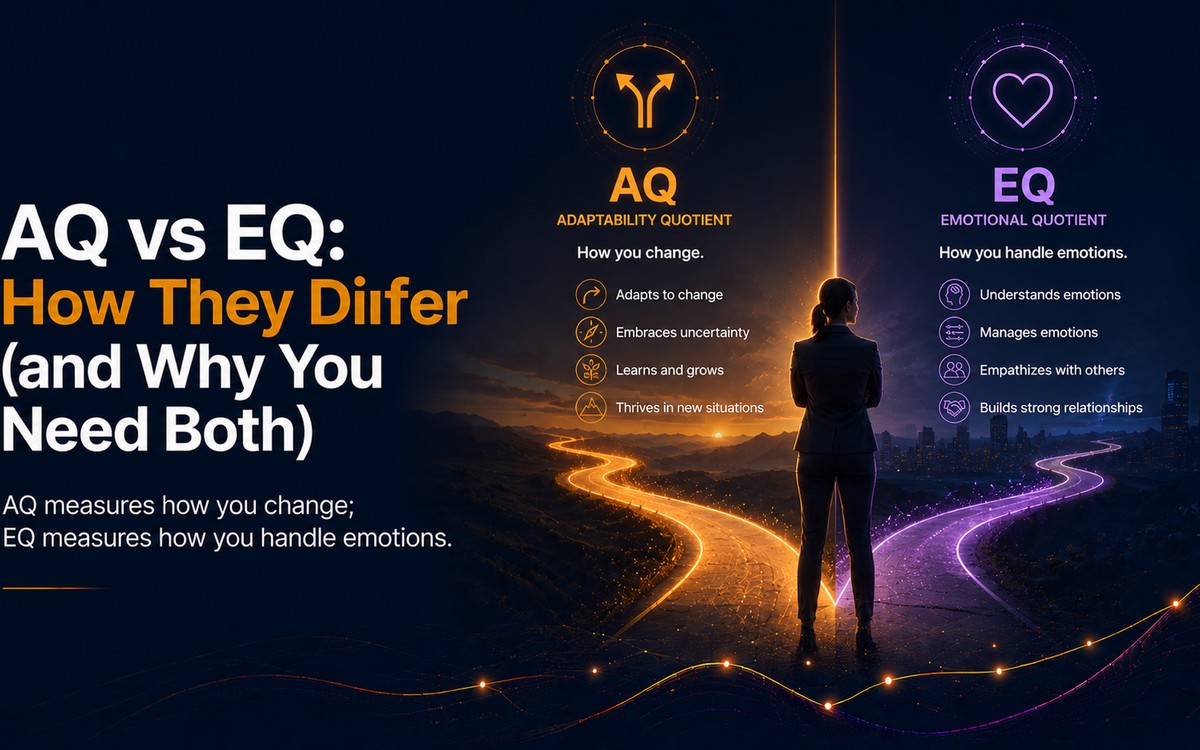
Adaptability Quotient and Emotional Intelligence are related but distinct. Here is exactly how AQ and EQ differ, where they overlap, and why modern work demands both.
Adaptability Quotient (AQ) measures how well you change: how you respond to new situations, unlearn what no longer works, and grow through uncertainty. Emotional Intelligence (EQ) measures how well you understand and manage emotions, your own and other people's. They are related but distinct. EQ helps you read the room. AQ helps you change your behaviour when the room changes. You need both, and the two reinforce each other.
The short version: EQ is about emotional awareness and regulation in the moment. AQ is about the fuller capacity to adapt, spanning your abilities, your character, and the environment around you. One is a component of being human at work. The other predicts how you will perform when the work itself keeps shifting.
Adaptability Quotient (AQ), also called Adaptability Intelligence, is a measure of your ability to adapt: to respond to change, unlearn outdated habits, and grow in conditions of uncertainty. Where IQ describes reasoning power and EQ describes emotional skill, AQ describes how effectively you navigate change itself.
AQai measures AQ through the A.C.E. model, which looks at adaptability across three domains rather than treating it as a single trait. Ability covers the skills of adapting, things like grit, mental flexibility, unlearning, and resilience. Character covers who you are when you adapt, including your motivation style, your drive, and how you handle risk and hope. Environment covers the conditions around you, because the same person adapts differently under supportive versus draining circumstances. Adaptability is not just something you carry inside you; it is shaped by your team, workload, and surroundings.
That third domain is where AQ departs most sharply from personality and emotional models. AQ treats context as part of the measurement, not as noise to be controlled for.
Emotional Intelligence (EQ) is the ability to recognise, understand, and manage emotions, both your own and those of others. The term was introduced by psychologists Peter Salovey and John Mayer in 1990 and popularised by Daniel Goleman in his 1995 book Emotional Intelligence. Goleman's widely cited framework describes five elements: self-awareness, self-regulation, motivation, empathy, and social skills, which he later refined into four domains. Salovey and Mayer's original model, by contrast, defines EQ as a set of abilities across four branches.
EQ has become a staple of leadership development for a good reason. Emotional awareness underpins trust, communication, and the ability to lead people rather than just manage tasks. Common EQ assessments include the EQ-i 2.0 (based on Reuven Bar-On's model) and the MSCEIT (the Mayer-Salovey-Caruso Emotional Intelligence Test), which approach EQ as either a set of self-reported competencies or an ability to be tested.
The point of comparing AQ and EQ is not to diminish EQ. It is to be precise about what each one measures, so you develop the right capability for the challenge in front of you.
The clearest way to see the difference is by what each one predicts. EQ predicts how well you understand and manage emotions in a given moment. AQ predicts how well you change your behaviour, and keep performing, when the situation shifts.
Three differences stand out. First, scope: EQ is centred on the emotional domain, while AQ spans abilities, character, and environment, with emotional regulation as one part of the wider picture. Second, focus: EQ is largely about the present moment and how you handle it, while AQ is about movement over time, unlearning, reskilling, and adjusting as conditions change. Third, context: most EQ models locate intelligence inside the individual, while AQ explicitly measures the environment, recognising that adaptability rises and falls with the conditions someone is in.
A simple way to hold it: EQ helps you stay composed and connected when a change lands. AQ determines whether you can actually change what you do in response. You can be highly emotionally intelligent and still resist changing your ways. Adaptability is what closes that gap.
They overlap in the emotional machinery of change. Managing anxiety under uncertainty, staying motivated when the path is unclear, and reading how others are coping are all emotional capabilities, and they all feed adaptability. In the A.C.E. model, several Character and Ability elements draw on the same self-awareness and self-regulation that EQ describes.
So EQ is best understood as one of the ingredients of adaptability rather than a rival to it. Strengthening your emotional intelligence tends to support your adaptability, particularly the parts that involve staying steady and hopeful when things are in flux. The difference is that AQ then goes further, into behaviour change, unlearning, and the environmental conditions that EQ frameworks do not typically address.
Because emotional skill and adaptability solve different problems, and modern work demands both. High EQ without adaptability produces leaders who are liked and trusted but slow to change course when the strategy, market, or technology shifts. High adaptability without EQ produces people who change quickly but leave others behind in the process. The combination, emotional awareness plus the capacity to adapt, is what lets individuals and teams move through transformation without losing the people in it.
This matters more now than it did a decade ago. The pace of change driven by AI, restructuring, and shifting markets means the ability to adapt has become a core performance variable, not a soft extra. EQ helps you lead humans through that change. AQ tells you whether they, and you, can actually make the change stick.
EQ is typically measured through instruments like the EQ-i 2.0 or the MSCEIT, which assess emotional competencies or emotional ability. AQ is measured differently, because it has to capture adaptability across the three A.C.E. domains rather than a single dimension.
The AQme assessment measures an individual's AQ across the abilities, character traits, and environmental factors that shape how they adapt, producing a profile rather than a single score. That profile is designed to be developmental: it shows where someone's adaptability is strong, where it is being drained by their environment, and where deliberate practice would help most. If you want to see what measuring adaptability looks like in practice, the AQme assessment is the entry point, and the A.C.E. model explains what sits behind it.
The important distinction for measurement is that AQ does not treat context as background. Two people with similar traits can return different adaptability profiles because their environments differ, and AQ is built to surface exactly that.
EQ matters most in the human moments: difficult conversations, building trust, leading a team through emotion-heavy situations, and any relationship where being understood is the goal. If your challenge is connection, EQ is the lever.
AQ matters most when the situation itself is changing: a reorganisation, a new technology to absorb, a market shift, a career pivot, or any moment that asks you to unlearn something and do it differently. If your challenge is change, AQ is the lever. Most real leadership challenges involve both at once, which is why developing them together, rather than choosing between them, is the stronger play.
No. EQ (Emotional Intelligence) measures how well you recognise and manage emotions, while AQ (Adaptability Quotient) measures how well you adapt to change across your abilities, character, and environment. Emotional regulation is one ingredient of adaptability, so EQ overlaps with AQ but does not replace it.
Neither is universally more important; they solve different problems. EQ is the lever for human connection and leading people through emotion, while AQ is the lever for navigating change, unlearning, and reskilling. In a fast-changing environment you need both, and they reinforce each other.
Yes. Someone can be highly emotionally intelligent, self-aware, empathetic, socially skilled, and still struggle to change their own behaviour when the situation demands it. That gap between reading the moment well and actually adapting is precisely what AQ measures and helps develop.
AQai measures AQ using the A.C.E. model through the AQme assessment, which profiles adaptability across Ability (the skills of adapting), Character (who you are when you adapt), and Environment (the conditions that help or hinder). Unlike most emotional intelligence tools, it treats your environment as part of the measurement rather than as background.
Yes. Like EQ, AQ is not a fixed trait. Once adaptability is measured, the profile shows where to focus, and specific abilities, character strengths, and environmental changes can be developed deliberately over time.
If EQ has been part of your development story and you want to understand the capability sitting right next to it, start by seeing how adaptability is measured. Explore the A.C.E. model to understand the three domains of AQ, or take the AQme assessment to see your own adaptability profile.
Copyright adaptai Ltd. All rights reserved. AQ® and AQai® are registered trademarks of adaptai Ltd.


.png)
.png)

