
AQai co-founder Mike Raven led a follow-up to the AQai and Prosci webinar: asking both the stage question (ADKAR) and the conditions question (AQ). Three worked cases show the combined diagnostic in action.
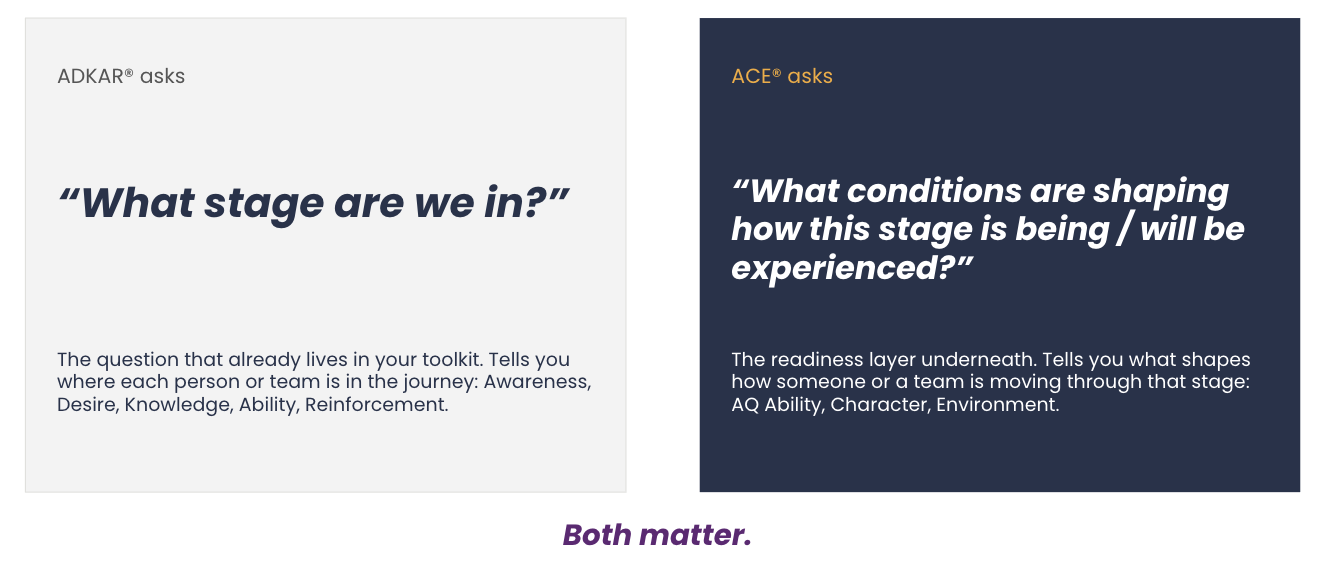
Changing how we change starts with asking two questions instead of one. The first is the question Prosci's ADKAR® model answers: what stage is each person or group in, across Awareness, Desire, Knowledge, Ability and Reinforcement? The second is the question AQai's ACE® model answers: what condition is shaping how that stage is experienced? Ask both together and you understand not only where someone is on the change journey, but what is making that part of the journey feel the way it does. That pairing was the heart of the second AQai and Prosci session, "Changing How We Change", led by AQai co-founder Mike Raven as a follow-up to the first joint webinar three weeks earlier.
As Mike put it, this is not about replacing models, it is about combining them, because ADKAR® shows the journey and ACE® shows the conditions underneath, and both matter. Put together they act as change success multipliers. This piece walks through the three worked cases the session used to show what asking both questions looks like in practice.
The first AQai and Prosci webinar drew more than 700 registrations and a large live audience, and many people who watched the recording afterwards asked for more. This second session was the response. Mike Raven ran it solo, with the AQai team supporting in the background, and the format was deliberately practical: three new worked cases, two live polls, and an open Q&A.
The cases all draw on the diagnostic the two organisations have been developing together: a 15-cell matrix that crosses ADKAR®'s five stages with ACE®'s three dimensions (Ability, Character, Environment), where each cell is a diagnostic question. The first session worked three of those cells live. This one took on three more: the senior leader sponsor gap, an M&A integration, and what Mike calls reinforcement drift.
The reframe worth holding onto is simple. ADKAR® answers "what stage are we in?" and gives a shared language for naming it. ACE® answers "what condition is shaping that stage?", looking at the ability a person brings, the character lens through which they experience change, and the environment they are changing inside. Same transformation, two complementary questions, and the most useful work happens where the answers meet.
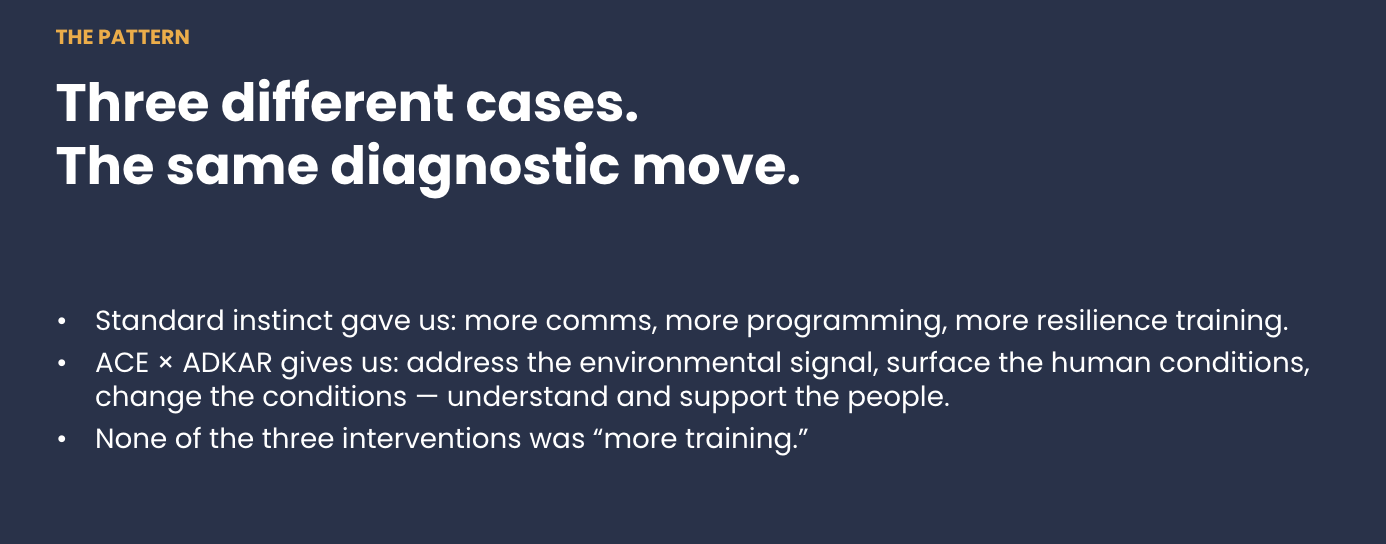
It matters because the familiar reflex, when a change needs help, is to reach for more communication, more programming, or more training. Sometimes that is exactly right. Asking both questions together makes sure the effort lands where it will count, on the specific condition shaping the stage in play, rather than on the response we reach for by habit. As the three cases show, the most precise move is often something other than "do more training".
Picture a mid-sized organisation of around 2,500 people, four months into a major transformation, with the stakeholder mapping, comms plan and ADKAR® diagnostic all in good shape. The ADKAR® diagnostic answers the first question clearly: desire is the stage to focus on. The second question, what condition is shaping desire here, is where AQ adds resolution.
Looking at the environment, two sub-dimensions are at work. Company support: if a CEO references the change inconsistently in town halls, the environment quietly signals that it is optional, and that signal travels further than any official message. Team support: when one executive visibly works around the change while two support it, people calibrate against the visible outlier rather than the average. Read together, the two questions point to the same insight: desire is shaped less by individual will here and more by what the environment is signalling about whether the change is real.
The interventions follow naturally. Address the environmental signal directly, with a conversation with the outlier executive about visibility rather than behaviour, opening with a useful question: what do you need to be able to back this publicly? Make peer support visible, with the supportive executives committing specifically, through real narrative tied to the change rather than slogans. And give the CEO something concrete to own: rather than "more communication", invite responsibility with evidence, since AQai's research indicates senior leaders can have up to 39 times more impact on an organisation's adaptability through change.
Mergers and acquisitions are fundamentally a systems challenge, which is why this case spans two cells: awareness and character, alongside reinforcement and environment. Picture an acquirer integrating a 400-person business eight weeks after the deal closes, with the usual cultural integration in place: town halls, meet-and-greets, value-alignment sessions. ADKAR® answers the first question well, with reinforcement readings showing that people are following the new processes. The second question, what conditions are shaping how this is experienced, is where the fuller picture appears, because three of the acquired company's best people have resigned and engagement in that population has dropped.
Two conditions explain it. In an M&A, awareness is less about understanding what is happening and more about the emotional bandwidth to make meaning of a disruption to identity, as people who built their sense of self at the acquired company are asked to absorb someone else's. That takes emotional range. Alongside it sits team support: people follow the new processes, while the informal culture, how decisions actually get made, is still the old way, so compliance and quiet cultural drift run side by side.
Three moves help. Run AQme assessments across the acquired group in week one rather than month six, so flight-risk talent surfaces early enough to act, since the cost of losing three senior people comfortably exceeds a year of assessment data. Give the population visible meaning-making space, not as therapy but as structured peer-to-peer conversations about the identity transition. And renorm the team environment deliberately, choosing by consensus which of the acquired culture's decision rituals to adopt and which to retire, because people are navigating ambiguity rather than resisting, and old rituals are the path of least resistance. As proof at scale, one AQai client, a global engineering firm, has run more than 50 acquisitions using the AQ diagnostic throughout, describing the tool as preemptive: a way to support the people merging in rather than discovering the cost months later.
The third case came from the single most-reacted comment of the first session: that people are simply tired of being resilient through so much change. Picture a large financial-services firm 18 months into a sustained transformation, with new ways of working, tools and an operating model that have embedded well, and ADKAR® answering the first question positively, with reinforcement scores mostly green. The second question, what condition is shaping that reinforcement, is the one that turns "we've done the change" into "and here is how to keep it healthy", because engagement has dipped over recent quarters and the highest-capacity teams are feeling the strain.
The condition here is environmental. Work stress, in this reading, is about capacity: when an organisation runs 18 months of compounding change without proportional investment in protected time, manageable workload and leader bandwidth, the load concentrates on the people who keep absorbing it. This is not abstract. In a live poll during the first session, 78 percent of attendees said they were dealing with six or more concurrent large changes, and around 15 percent said they had simply stopped counting.
Three moves follow. Measure work stress as a leading indicator rather than a lagging one, because engagement scores report a drop after it has happened, while the environment scores in the AQ assessment show the conditions producing it, ideally 90 days earlier, giving a runway to act. Cap concurrent change at team level with an explicit limit, since around three simultaneous changes tends to be the ceiling for sustained performance, not five, six or eight. And protect leader time deliberately, because leaders carry that outsized impact on adaptability, and the reinforcement they are meant to provide needs real bandwidth rather than a side-desk slot.
The same two questions ran through all three cases, and in each, asking them together pointed effort at the specific condition that would move things, rather than the response reached for by habit. Notably, none of the recommended interventions was "do more training". The most useful line from the session captures the spirit of it: we change the conditions, not the people. Conditions are the part organisations and the consultants who support them can most directly shape, and a clear read of them is what makes the combined approach so valuable.
That is also why the two methodologies sit so well together. ADKAR® provides the structure, the sequence and the shared language of the change journey. AQ provides the readiness layer underneath, the diagnostic of the conditions. Asking both questions as a matter of routine is what changing how we change really means, and it lets a change leader move from naming the stage to understanding the condition shaping it, and then to an intervention more precise than one question alone would produce.
If you already lead change with ADKAR®, AQ is the layer that makes your existing practice sharper, and AQai runs pathways from a short self-paced course for practitioners through to full certification, including a dedicated Prosci and AQai integration session, for those who want to put both questions to work together.
ADKAR® answers "what stage is each person or group in?" across its five stages, and AQai's ACE® model answers "what condition is shaping that stage?" across Ability, Character and Environment. AQai maps them as a 15-cell matrix where each cell is a diagnostic question. Asking both together points an intervention at the specific condition that will move things, which is why AQai and Prosci describe the combination as a success multiplier rather than a replacement.
AQ's ACE® model groups them into three: ability (the trainable skills someone brings to adapting), character (the lens through which they experience change, such as emotional range and hope), and environment (company and team support, and work stress). In the worked cases, environmental signals shaped desire, emotional range shaped an M&A integration, and work stress shaped how a long programme was sustained.
Reinforcement drift is a name for what can happen in a long, sustained transformation: the change embeds well, and the condition worth watching becomes capacity. Sustained change without proportional investment in protected time, workload and leader bandwidth concentrates the load on the highest-capacity people. The signal to track is work stress, measured as a leading indicator ideally 90 days ahead of any engagement dip.
Yes. In an M&A, two human conditions matter most: the emotional bandwidth to absorb a disruption to identity, and the informal culture of the acquired company that runs alongside formal adoption. Running an adaptability assessment across the acquired population in the first week surfaces flight-risk talent early, and deliberately renorming team rituals supports the cultural integration.
No. ADKAR® provides the structure, sequence and shared language of the change journey, and AQ adds the diagnostic of the conditions underneath. They are designed to pair, many practitioners are certified in both, and AQai offers a dedicated Prosci and AQai integration session for those who want to use both questions together.
The three cases above are patterns, not prescriptions, so the best next step is to check your own situation against them. A short consultation with the AQai team maps your specific challenge, whether it's a sponsor gap, an M&A integration, or reinforcement drift, to the right AQ diagnostic and intervention. Book a consultation call to talk it through.
The three cases all turned on reading the condition underneath the stage. To put both questions to work on a change you're leading, take your AQme and learn the ACE × ADKAR diagnostic in AQ Essentials, a short self-paced course for practitioners, with pathways through to full certification and the dedicated Prosci × AQai integration session.
Copyright adaptai Ltd. All rights reserved. AQ® and AQai® are registered trademarks of adaptai Ltd.


.png)
.png)

