
AQai's Ross Thornley and Prosci's Tim Creasey hosted a joint webinar on 6 May 2026. Here is how the ACE model and ADKAR work together as complementary tools for change leaders.
When AQai co-founder Ross Thornley and Prosci Chief Innovation Officer Tim Creasey hosted their first joint webinar on 6 May 2026, the throughline was clear from the opening minutes: change management and adaptability intelligence are stronger together. Prosci's ADKAR® model maps the journey of change and the outcomes that make it stick. AQai's ACE® model measures the human conditions people travel that journey in. Used as a pair, they give change leaders both the map and the readiness layer underneath it.
Adaptability Intelligence (AQ) is the measurable capacity of a person, team or organisation to adapt effectively to change. ADKAR® is Prosci's model of the five outcomes an individual moves through during a successful change. The two were built from different starting points, and the session was a live demonstration of how naturally they fit alongside each other.
More than 700 people registered and the room stayed busy. It was, as both hosts put it more than once, a conversation rather than a presentation, with polls, chat and a steady stream of practitioner stories from two communities meeting in one place.
AQai and Prosci come from a shared root. Prosci was founded by a researcher, and AQai grew out of Ross Thornley and Mike Raven's research into how organisations adapt at the edge of innovation. Both organisations care about the same thing: helping real people through real change in a way Tim Creasey summed up as building "the confidence and competence to step boldly into the hard change in front of them."
The partnership is a genuine cross-pollination. Mike Raven was completing his Prosci ADKAR® certification at the time of the webinar, and joined briefly to say so. Prosci team members have gone through the AQ assessment. Practitioners are already certified in both. The joint session was the natural next step: two methodologies, two communities, one conversation about supporting people through change.
A useful frame Tim offered, borrowed from the statistician George Box, ran through the whole session: all models are wrong, but some are useful. Every model gives a partial view of reality. The interesting question is not which model wins, but how useful views combine.
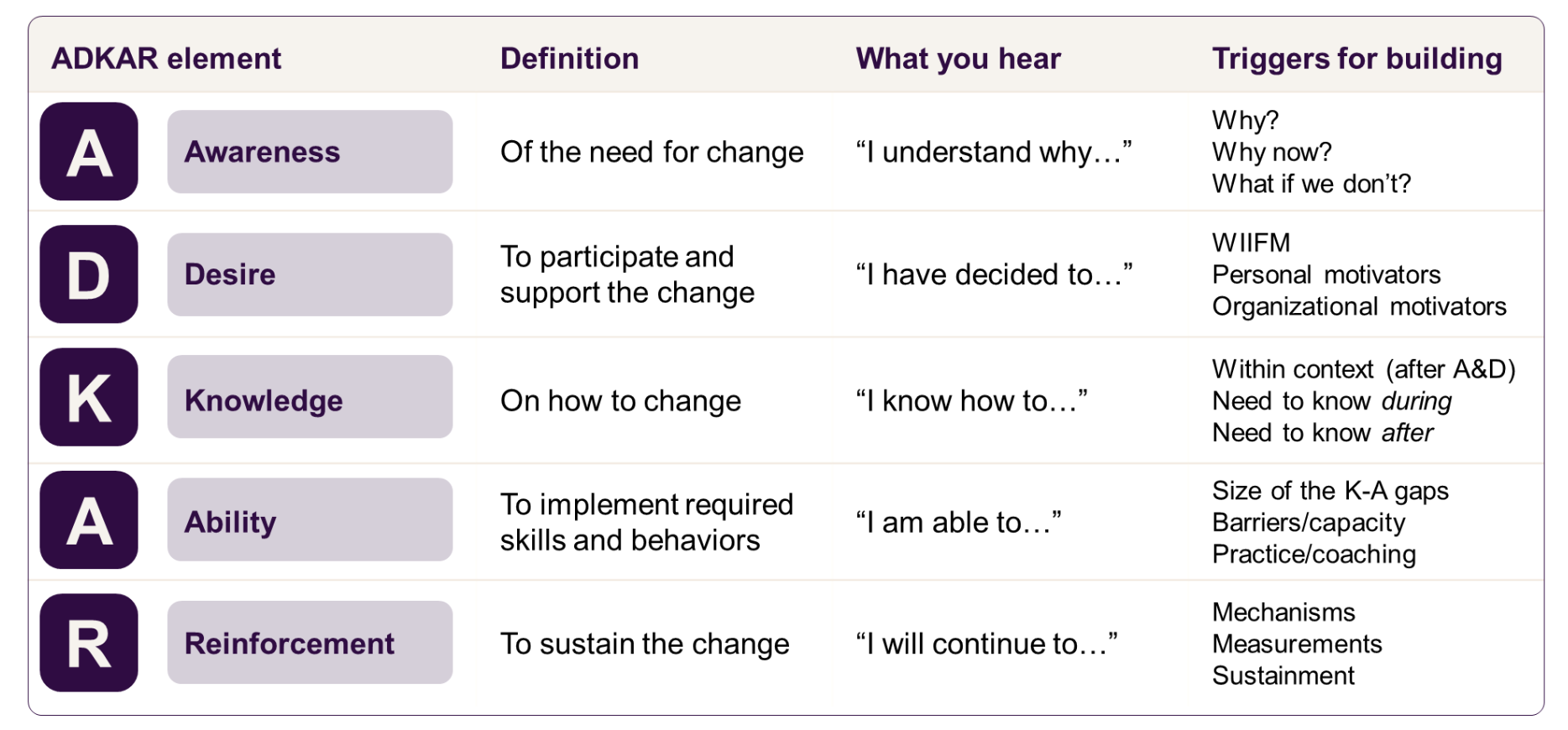
ADKAR® describes the five building blocks of successful individual change: Awareness of the need to change, Desire to take part, Knowledge of how to change, Ability to apply that knowledge, and Reinforcement to make the change last. Prosci's founder Jeff Hiatt built the model by asking why each change activity matters, and the answer became the five outcomes themselves.
Two points Tim made are worth holding onto. First, ADKAR® describes outcomes, not activities. Communicating, motivating and training are things a project team does; awareness, desire and knowledge are the results those activities are meant to create in people. Second, the model is sequential but not linear. The five outcomes build in order, but a person ebbs and flows between them rather than marching through in a straight line. Reinforcement sitting deliberately at the end is what turns a change that happens into a change that holds.
This is the strength ADKAR® brings to the pairing: a clear, proven map of where a person is on the change journey, and a shared language for naming it.
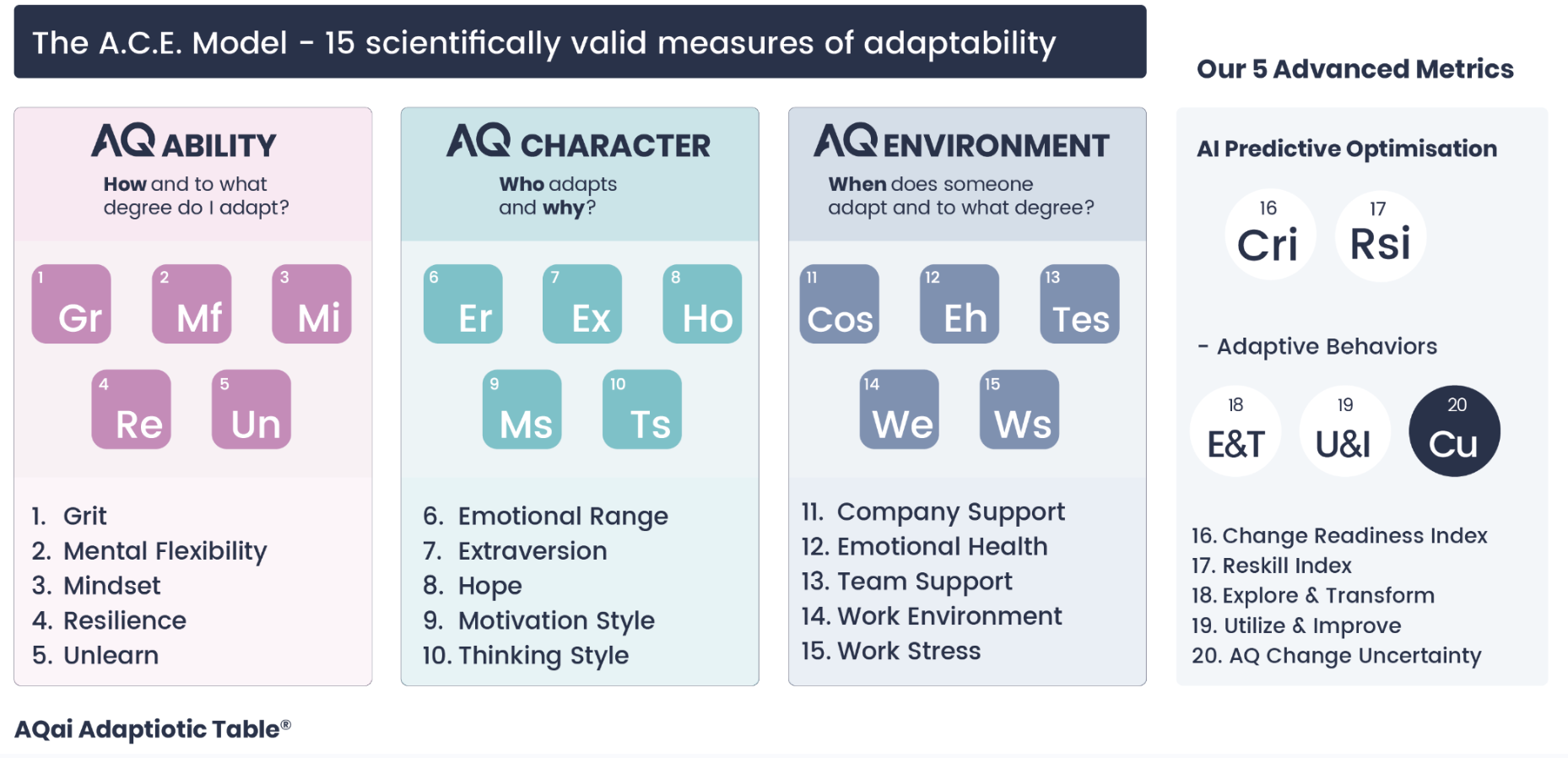
Where ADKAR® maps the journey and its outcomes, AQai's ACE® model measures the human conditions a person carries into that journey. ACE® stands for Ability, Character and Environment.
Ability is how, and to what degree, a person adapts. These are trainable, measurable skills, each backed by scientific research, including mental flexibility, the capacity to unlearn, resilience grounded in the Brief Resilience Scale, and grit. Character is who adapts and why: five dimensions sitting on a continuum rather than as good or bad traits, including emotional range from reactive to collected, and hope, which AQai measures using Snyder's research as a combination of goals, pathways and the agency to follow them. Environment is when and where a person adapts: the level of company and team support, and work stress, measured specifically as task overwhelm during change.
On top of these, the assessment generates predictive indexes, including a Change Readiness Index that weights eight factors across ability, character and environment, and a reskilling measure. As Tim described it after taking the assessment himself, ACE® is like peeling back the onion to see the underlying conditions, the layer beneath the journey.
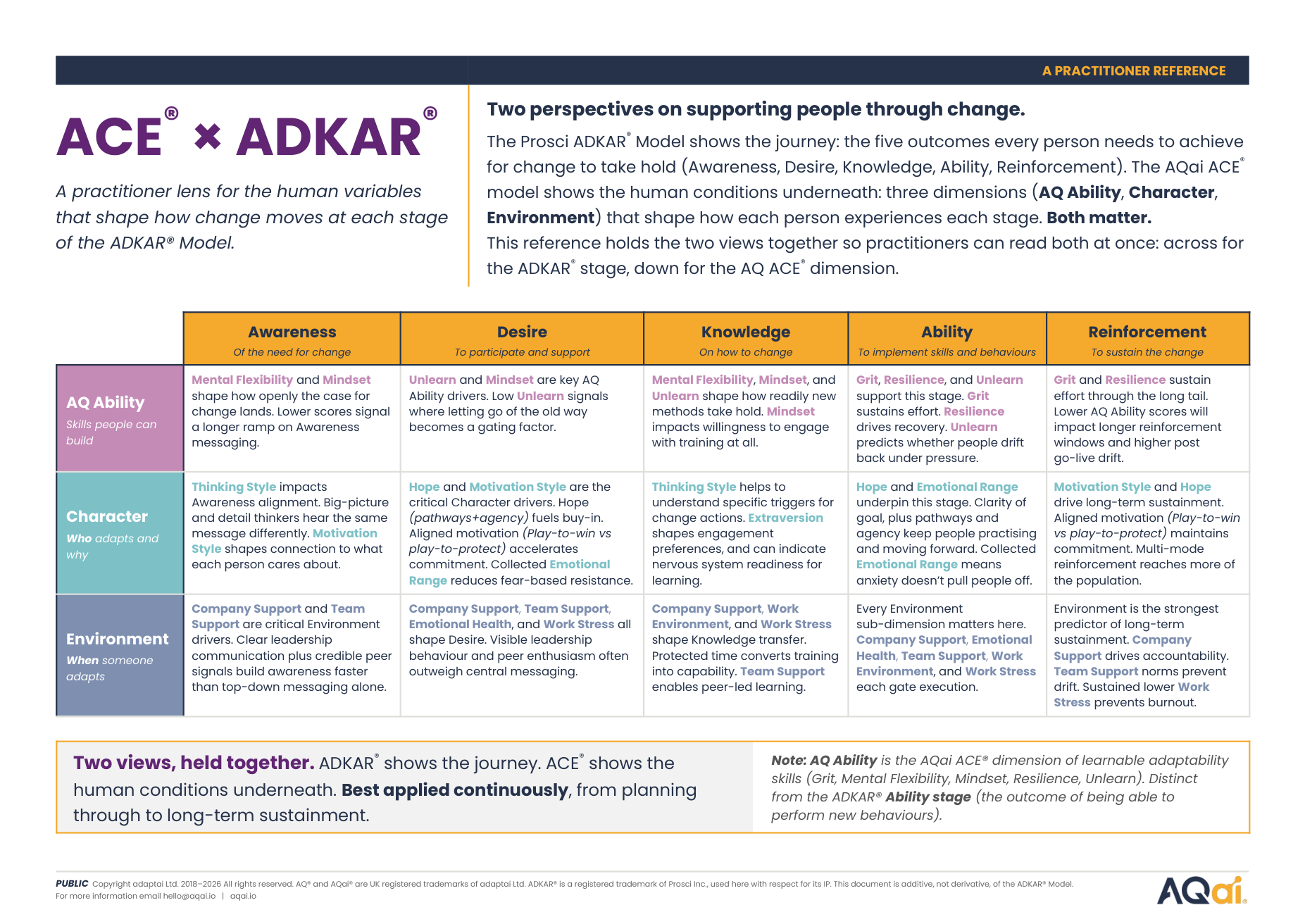
The simplest way to hold it: ADKAR® is the journey and the outcomes, AQ is the readiness layer underneath. ADKAR® tells you where a person is. AQ adds fidelity to why they are there and what will help them move. Run together, the two become what both hosts called a force multiplier on the value of change work.
Ross and Tim made this concrete with a worked example the whole audience could recognise: an organisation of 200 people rolling out a new internal AI assistant. Ten weeks in, awareness is high, training is complete, and yet active adoption has plateaued around 40 percent. The instinct in most organisations is to reach for more training and more communication.
The first move both hosts modelled was an ADKAR® move: of the people who have stalled, where exactly are they stalling? That diagnostic question is what stops a team defaulting to "more training" and starts it looking at the specific outcome people are stuck on. AQ's ACE® conditions then help answer that question with more fidelity.
Take hope, one of the dimensions AQai measures, which in their data science carries one of the strongest correlations across the whole model. If desire looks low, hope adds resolution: does the person actually have a pathway from here to there, and the agency to walk it? Sometimes the issue is not that someone has decided against the change, but that they cannot yet see the route. Take unlearning, the skill of intentionally letting go of a previously successful way of working. Sometimes what looks like a knowledge gap is really the harder work of unlearning an old habit that still pays off just often enough to cling to. And take work stress: when adoption clusters low in particular teams, the condition holding them back may not be skill or willingness at all, but task overwhelm and a simple lack of capacity to take one more thing on.
In every case the pattern is the same and worth stating plainly: ADKAR® names the stage, AQ illuminates the condition shaping that stage, and the intervention that follows is more precise than either lens would produce alone. Build pathways and reinforce agency rather than running another training session. Redesign the workload rather than pushing harder on a team that has no room. That is the move from friction to flow, and it is what the pairing unlocks.
The backdrop to all of this is a pace of change that keeps climbing. Drawing on Prosci's research, Tim described change shifting from episodic to continuous and from fast to faster, with employees today exposed to many times the number of initiatives they once were, and around three-quarters of organisations at or near a saturation point. Prosci's long-running research also points to the prize for getting the people side right: organisations with excellent change management are far more likely to meet objectives than those with poor change management.
AI sharpens the need. As Ross put it, AI does not care about jobs, it cares about tasks, which makes the human capacity to adapt, unlearn and reskill the real determinant of whether an AI rollout lands. Reskilling, learning to do something genuinely new in a different domain, is different from upskilling, getting better at what you already do, and AQai builds a specific measure for how ready a person is to reskill. In a continuous-change world, that readiness is fast becoming the skill of the moment, and measuring it is exactly the readiness layer ADKAR®-led change benefits from.
The most encouraging part of the session came from the community itself. One Prosci-certified practitioner described running a combined session with an AQai-certified colleague for several leadership teams, and finding the synergy of the two methodologies genuinely effective in practice. Another shared how she had linked the Environment dimension of ACE® directly to her organisation's culture and values, using the assessment as a bridge to make culture visible and measurable for both leaders and individual contributors.
That, in the end, is the point both hosts kept returning to. These models and assessments are a means to an end. The more they bridge to real projects, real teams and the change actually in front of you, the more useful, and as the AQai team likes to add, the more joyful, the work becomes.
Adaptability Intelligence has now been measured across nearly 19,000 assessments (as of April 2026), and the AQai and Prosci communities are increasingly working across both. If you lead change and already use ADKAR®, AQ is the readiness layer that makes your existing practice sharper. If you are coming to this fresh, the two together are a strong place to start.
ADKAR® maps the journey of change through five outcomes (Awareness, Desire, Knowledge, Ability, Reinforcement), telling you where a person is. AQai's ACE® model measures the underlying human conditions (Ability, Character, Environment) that shape how they move through it. Used together they are complementary: ADKAR® names the stage, AQ adds fidelity on why someone is there and what will help, which is why both AQai and Prosci describe the combination as a force multiplier.
No. They solve different parts of the same challenge and are designed to pair. Prosci's ADKAR® and methodology guide the structure and sequence of a change; AQ measures the readiness and conditions of the people going through it. Many practitioners are now certified in both and run them side by side.
ADKAR® is a sequential model of the five outcomes that make individual change succeed, focused on the journey and what makes change stick. ACE® is AQai's model of adaptability across three areas, Ability, Character and Environment, focused on the measurable human conditions a person brings to change. One describes the path; the other describes the readiness layer underneath it.
Yes, and the AQai and Prosci webinar on 6 May 2026 was a live demonstration of exactly that. The combination lets a change leader move from identifying where people are stalled, an ADKAR® question, to understanding the condition behind it, such as hope, the difficulty of unlearning, or work overwhelm, and then choosing a more precise intervention.
AI rollouts tend to stall not on the technology but on the human capacity to adapt to it. As AQai's Ross Thornley put it, AI does not care about jobs, it cares about tasks, so the ability to unlearn old habits and reskill into new ways of working is what determines whether adoption lands. Measuring that readiness, alongside a structured change approach like ADKAR®, gives change leaders a fuller picture.
Yes. The clearest way to find out whether adaptability intelligence fits your situation is to talk it through with the AQai team. Whether you are running an AI rollout, an M&A integration, or a long transformation, a short consultation maps your challenge to the right AQ approach and to where it pairs with your existing ADKAR®-led work. Book a consultation call to explore your specific case.
The fastest way to feel the two lenses for yourself is to experience the ACE model first-hand. Take your AQme assessment and learn how to apply it alongside ADKAR® in AQ Essentials, the self-paced course built for change practitioners. If you already lead change with ADKAR®, this is the readiness layer that makes your existing practice sharper.
Copyright adaptai Ltd. All rights reserved. AQ® and AQai® are registered trademarks of adaptai Ltd.


.png)
.png)

